DLSS vs. FSR: Which Upscaling Tech Delivers Better Performance?
When a new generation of GPUs rolls out, the conversation shifts from raw power to how efficiently that power is harnessed. Two names keep popping up in this debate: NVIDIA’s Deep Learning Super Sampling (DLSS) and AMD’s FidelityFX Super Resolution (FSR). Both promise higher frame rates without sacrificing visual fidelity, yet their approaches differ dramatically. Let’s break down the core differences, real‑world impact, and which might be the better fit for your setup.
Understanding the Basics: DLSS vs. FSR
At their hearts, both DLSS and FSR are upscaling techniques, but they use distinct technologies.
- DLSS relies on a neural network trained by NVIDIA. It uses a lower‑resolution reference frame, a high‑resolution “target” frame, and a set of pre‑trained weights to reconstruct a sharp image. The neural net is run on NVIDIA’s Tensor Cores.
- FSR is an algorithmic approach that performs spatial or temporal upscaling. It doesn’t need machine learning; instead, it uses edge detection and motion vectors to produce sharper results from a low‑res source.
Because DLSS uses hardware‑accelerated AI, it can achieve higher fidelity with less bandwidth, while FSR offers broader compatibility across AMD and NVIDIA GPUs, even older models.
Performance Gains in Real‑World Games
Benchmarks often reveal the most persuasive data. In 2023 titles like Cyberpunk 2077 and Red Dead Redemption 2, DLSS 3.0 (the latest iteration) can deliver +30–50% frame‑rate increases at 4K resolution compared to native rendering. FSR 2.0, on the other hand, typically offers 15–25% boosts on the same hardware. However, the difference narrows on mid‑range cards where the Tensor Core advantage diminishes.
In GPU‑heavy scenes, DLSS excels because its AI can intelligently reconstruct details that would otherwise require additional render passes. FSR’s strength lies in its simplicity—no extra hardware needed, which makes it viable for integrated GPUs and older GPUs that lack dedicated AI cores.
Visual Quality: Sharpness, Artifacts, and Color Fidelity
Visual output is a common battleground:
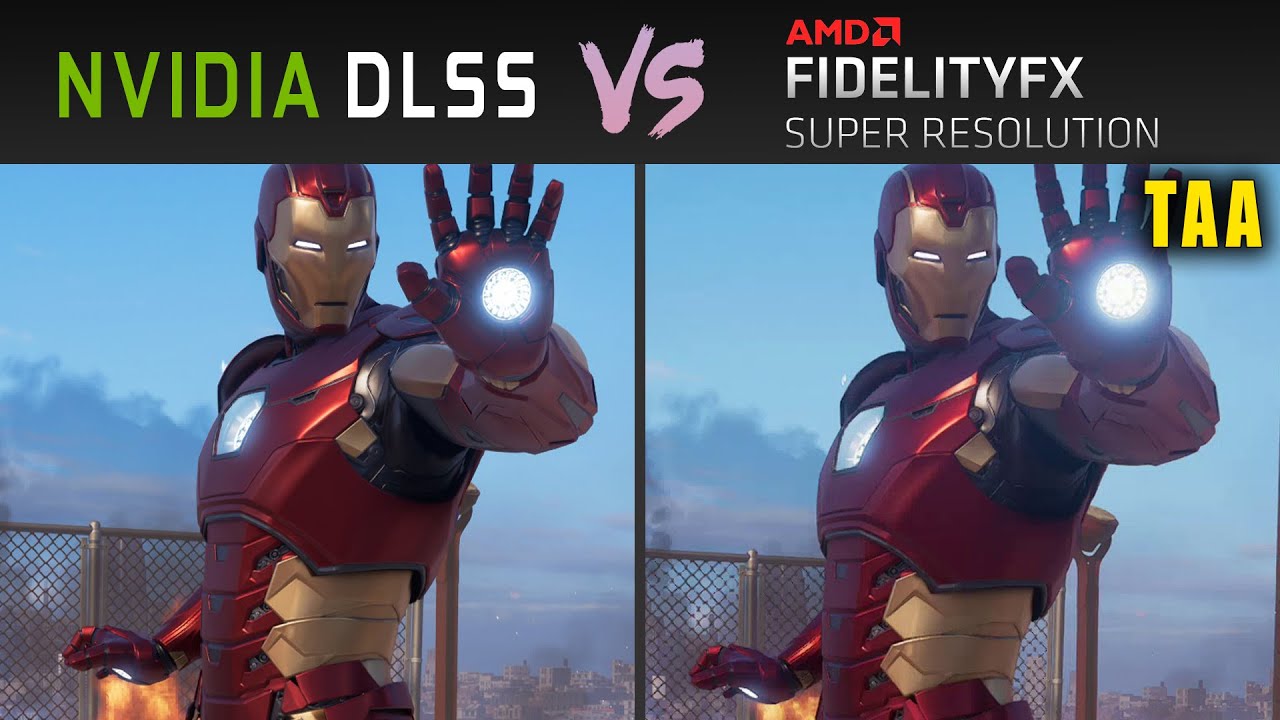
- DLSS generally produces images that match or surpass native resolution in clarity. The neural net is adept at preserving fine textures, though early DLSS 1.0 versions sometimes introduced “halo” artifacts. DLSS 2.0 and 3.0 have largely eliminated this issue.
- FSR can introduce slight blurring, especially at 60% upscaling. FSR 2.0 improves this by incorporating temporal data, yet the edges may still feel less sharp than DLSS, particularly in highly detailed scenes.
Color accuracy remains largely intact across both solutions. For gamers who prioritize crisp visuals without compromising frame rates, DLSS still holds an edge, provided they have an RTX card.
Hardware Compatibility and Future Proofing
When choosing between the two, consider the ecosystem:
- NVIDIA DLSS is exclusive to RTX series GPUs (3080, 3070, 3060, 3050, etc.). Future updates, such as DLSS 3.0, will continue to be tied to new RTX releases.
- AMD FSR runs on a wide range of GPUs—AMD RDNA 2, RDNA 3, and even some NVIDIA cards. FSR 3.0, released with the Radeon RX 7000 series, is compatible with both AMD and NVIDIA hardware, expanding its reach.
For users with budget constraints or older hardware, FSR offers an immediate performance boost without needing a new GPU. If you’re planning a future upgrade, DLSS might provide a longer lifespan in terms of cutting‑edge performance.
Developer Adoption and Game Support
Game developers weigh the cost of integrating each tech. DLSS often requires a partnership with NVIDIA, but it is increasingly available in high‑profile titles thanks to its proven performance. FSR, being open‑source and vendor‑agnostic, is adopted by a broader array of games, including those on consoles.
When a new game drops, DLSS support usually arrives first for RTX titles, while FSR follows slightly later. However, the gap narrows as developers see the benefits of both.
Choosing the Right Upscaling for Your Setup
Here’s a quick decision checklist:
- Do you own an RTX card? If yes, DLSS 2.0 or higher is typically the better choice for the highest frame rates and image quality.
- Are you on a budget or using an older GPU? FSR 2.0 or 3.0 is a solid, cost‑effective alternative.
- Do you play games that support both? Test each in your favorite titles; performance and image quality can vary by game engine.
- Do you need compatibility across multiple hardware vendors? FSR’s broader reach is a plus, especially if you switch brands.
FAQs
- Can I use DLSS on an NVIDIA GTX card? No, DLSS requires NVIDIA’s RTX series with Tensor Cores.
- Does FSR degrade image quality compared to native? FSR 2.0 and 3.0 maintain close fidelity to native, though slight softening may be noticeable in very detailed scenes.
- Will future game releases support both DLSS and FSR? Most developers are adding at least one of the two; many are aiming to support both to maximize audience reach.
- Is DLSS free for gamers? Yes, DLSS is enabled in compatible games at no additional cost.
In conclusion, if your GPU lineup supports DLSS, it usually offers superior frame‑rate gains and visual fidelity. AMD’s FSR shines in versatility and accessibility, making it a smart choice for those without RTX hardware or who want a quick performance lift across multiple devices. The best solution ultimately hinges on your current hardware, gaming priorities, and willingness to invest in an RTX upgrade.