From Kilometers per Hour to CFM: A Quick Conversion Guide
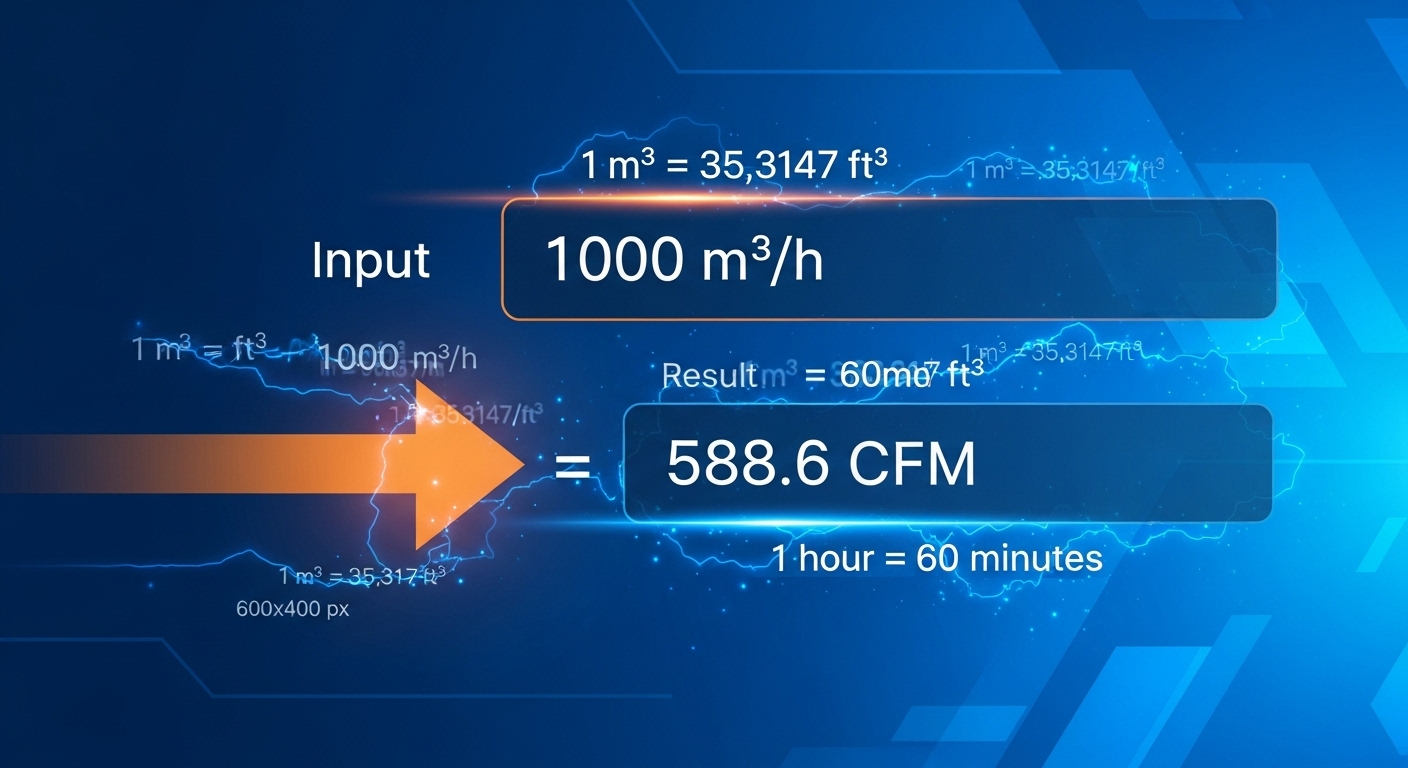
When engineers and HVAC technicians talk about airflow, they almost always use cubic feet per minute (CFM). At the same time, wind speeds, vehicle velocities, or pipe velocities are frequently expressed in kilometers per hour (km/h). If you find yourself needing to convert between these two seemingly unrelated units, you’re not alone. The conversion isn’t a simple one‑to‑one ratio because CFM reflects a volumetric flow rate, whereas km/h is a linear speed. This guide will walk you through the steps, formulas, and practical examples so you can make the jump from km/h to CFM with confidence.
How to Convert KM/H to CFM: A Simple Guide
The first thing to remember is that you need more than just the speed; you must also know the cross‑sectional area of the pipe or duct through which the air travels. Once you have that, the math is straightforward. Below is the step‑by‑step process:
- Step 1: Convert the speed from km/h to feet per minute (ft/min). One kilometer equals 3280.84 feet. There are 3600 seconds in an hour, so:
- Step 2: Multiply the foot‑per‑minute speed by the cross‑sectional area in square feet. The result is cubic feet per minute (CFM).
Let’s break each step down.
Step 1: km/h to ft/min
1 km/h = 3280.84 ft ÷ 3600 s ≈ 0.911344 ft/s. To get feet per minute, multiply by 60:
- 1 km/h ≈ 0.911344 × 60 ≈ 54.68064 ft/min.
So, if your air velocity is 10 km/h, the equivalent speed in ft/min is:
- 10 km/h × 54.68064 ft/min/km/h ≈ 546.8064 ft/min.
Step 2: Include the Cross‑Sectional Area
For a circular pipe or duct, the area (A) in square feet is calculated as:
- Diameter (d) in feet → radius r = d/2.
- A = π × r².
Suppose you have a 2‑foot‑diameter pipe:
- r = 1 ft.
- A = π × 1² ≈ 3.1416 sq ft.
Now multiply the velocity (in ft/min) by this area:
- CFM = 546.8064 ft/min × 3.1416 sq ft ≈ 1,717 CFM.
That’s the complete conversion: 10 km/h through a 2‑foot‑diameter pipe yields roughly 1,717 cubic feet per minute.
Common Conversion Tables
Below are handy tables for quick reference. They assume a 2‑foot diameter pipe but can be adjusted proportionally for other sizes.
Speed (km/h) | Velocity (ft/min) | CFM (2‑ft diameter)
- 5 km/h → 273.4 ft/min → 860 CFM
- 10 km/h → 546.8 ft/min → 1,717 CFM
- 15 km/h → 820.2 ft/min → 2,575 CFM
- 20 km/h → 1,093.6 ft/min → 3,432 CFM
To adapt these numbers to a different diameter, simply multiply by the square of the diameter ratio.
Practical Tips for Engineers and HVAC Professionals
- Measure accurately. Use a calibrated anemometer or flow meter to determine the velocity in km/h.
- Confirm the cross‑section. Pipes often taper or have fittings that reduce the effective area; account for these if precision matters.
- Mind the units. Double‑check that all lengths are in feet before squaring to get area.
- Use consistent units. If you prefer metric, convert the area to square meters and the result to cubic meters per second (m³/s), then convert to CFM if needed.
FAQ
What exactly is CFM?
Cubic feet per minute is a volumetric flow rate that measures how many cubic feet of air pass through a given point each minute.
Why do we need the pipe diameter for this conversion?
Speed alone tells you how fast air moves, but CFM depends on how much air moves. The area determines the volume per unit of time.
Can I convert km/h to CFM without knowing the area?
No. Without the cross‑section