How to Draft a Sweat Equity Partnership Agreement Template
When friends or co‑founders decide to pool their time instead of cash, they’re essentially trading sweat equity for a slice of the business. Turning that informal handshake into a legal document can feel daunting, but a well‑structured Sweat Equity Partnership Agreement Template does the heavy lifting. Below we’ll unpack why the template matters, what sections belong inside, and how to customize it without getting lost in legal jargon.
Understanding Sweat Equity and Its Legal Footprint
Sweat equity is the value you contribute through labor, expertise, or network connections rather than a monetary investment. In a startup, it’s common for a technical founder to receive shares for writing code while a marketer earns a stake for building brand awareness. The law treats these contributions just like cash—once documented, they become an enforceable ownership interest.
Without a clear agreement, disputes over who owns what, when shares vest, or what happens if someone quits can erupt. A template serves as a blueprint, ensuring everyone’s expectations are written down, reducing the risk of costly litigation later.
Why a Partnership Agreement Template Is Worth the Effort
Even a simple, one‑page outline can protect all parties. Here are three practical reasons to start with a template:
- Clarity. It spells out each partner’s role, the percentage of equity earned, and the timeline for vesting.
- Consistency. Using a standard format means you won’t overlook crucial clauses like dispute resolution or buy‑out provisions.
- Speed. A ready‑made structure lets you focus on customizing the numbers rather than reinventing the entire contract.
Core Elements Every Sweat Equity Template Should Contain
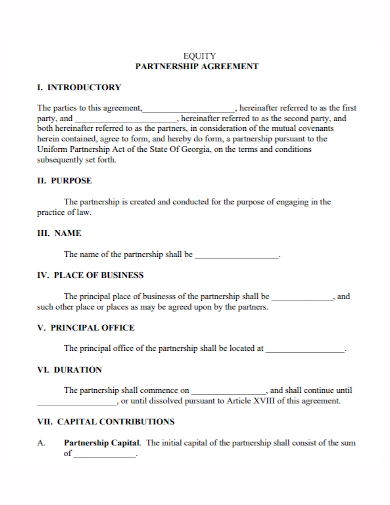
A solid template reads like a roadmap. Below are the sections you’ll typically find, along with brief explanations of what to include.
- Parties Involved. Full legal names, addresses, and the type of entity (LLC, corporation, partnership).
- Purpose of the Partnership. A concise statement describing the business’s mission and each partner’s contribution.
- Equity Allocation. Exact percentages or number of shares assigned for sweat equity, and how they compare to any cash‑based ownership.
- Vesting Schedule. Details on when equity becomes fully owned—common structures include a four‑year vesting with a one‑year cliff.
- Roles & Responsibilities. Specific duties each partner is expected to perform, helping prevent “I thought they were doing X” misunderstandings.
- Capital Contributions. Any cash, equipment, or intellectual property each partner is putting into the venture.
- Profit & Loss Distribution. How earnings and expenses will be shared, often mirroring equity percentages.
- Buy‑Out and Exit Clauses. Procedures if a partner wants to leave, including valuation methods and right‑of‑first‑refusal provisions.
- Confidentiality & Non‑Compete. Protection of trade secrets and limits on competing activities during and after the partnership.
- Dispute Resolution. Whether disagreements will be settled through mediation, arbitration, or court.
- Amendments. How the agreement can be modified—typically requiring a written, signed consent from all partners.
Step‑by‑Step Guide to Tailoring the Template
Now that you know what belongs in the document, here’s a practical workflow to make the template your own.
1. Gather Baseline Information
Start with a simple spreadsheet listing each partner’s full name, contact details, and the exact nature of their sweat contribution. Quantify time commitments where possible—e.g., “200 hours of software development over six months.”
2. Decide on Equity Split and Vesting
Run a quick equity calculator to see how the sweat contributions stack up against any cash investment. If you’re unsure, a common approach is to assign a market‑rate hourly value to the work and translate that into a percentage of total shares.
3. Insert Numbers into the Template
Replace placeholder text such as “[Partner A] receives 15% equity, vesting over 3 years” with the actual figures you derived. Be meticulous—mistakes here can cause headaches down the road.
4. Draft Role Descriptions
Instead of vague statements like “Partner B will handle marketing,” specify deliverables: “Partner B will launch three email campaigns per quarter and achieve a 5% click‑through rate.” This clarity helps enforce the vesting schedule.
5. Review Legal Provisions
Even a template can contain boilerplate language that doesn’t fit your jurisdiction. Pay special attention to buy‑out formulas and non‑compete durations, which may be subject to state‑specific limits.
6. Seek Professional Input
A quick review by an attorney—especially one familiar with startup equity—can catch hidden pitfalls. Many lawyers offer a brief “template audit” for a flat fee, which is far cheaper than full contract drafting.
7. Sign and Store Securely
All partners should sign the final document, ideally in the presence of a notary. Store a scanned copy in a cloud folder with restricted access, and keep the original in a safe place.
Common Pitfalls and How to Avoid Them
Even seasoned entrepreneurs stumble over a few recurring issues. Knowing them ahead of time can save you from re‑negotiating later.
- Over‑generous Vesting. A cliff that’s too long may demotivate a partner who’s already invested significant effort.
- Ambiguous Roles. Vague responsibilities lead to “scope creep” and disagreements about whether equity should accelerate.
- Ignoring Tax Implications. Sweat equity is often treated as income, triggering tax liabilities the moment shares vest. Consult a tax professional early.
- Failing to Update the Agreement. As the business evolves, so should the partnership terms. Schedule annual reviews to keep the document current.
Frequently Asked Questions
What’s the difference between a sweat equity agreement and a standard partnership contract?
A standard partnership contract typically addresses cash contributions and profit sharing. A sweat equity agreement adds clauses that value non‑cash labor, outline vesting schedules, and often include performance milestones tied to equity.
Do I need to issue stock certificates for sweat equity?
While not always required, issuing formal stock certificates (or electronic equivalents) helps document ownership and satisfies corporate formalities, especially for corporations.
Can I change the equity split after the agreement is signed?
Yes, but any amendment must be documented in writing and signed by all parties. Some templates include a built‑in amendment clause to streamline this process.
Is a notary necessary for a Sweat Equity Partnership Agreement?
Legally, a notary isn’t mandatory in most states, but notarization adds an extra layer of authenticity and can be useful if a dispute ever reaches court.
Using a Sweat Equity Partnership Agreement Template doesn’t eliminate the need for careful thought, but it does provide a reliable framework. By customizing the key sections, setting realistic vesting terms, and consulting a legal professional when needed, you’ll turn a hopeful collaboration into a solid, enforceable partnership.