Master Snell’s Law to Nail Precise Refraction Calculations
When light bends as it passes from one medium to another, the phenomenon is called refraction. Engineers, physicists, and even photographers rely on Snell’s Law to predict exactly how much that bend will be. Yet many learners stumble over the algebra, the sign conventions, or the subtle role of wavelength. This guide unpacks the law step by step, highlights common traps, and offers practical tips so your refraction calculations land on target every time.
Snell’s Law in Action: Calculating Refraction Angles
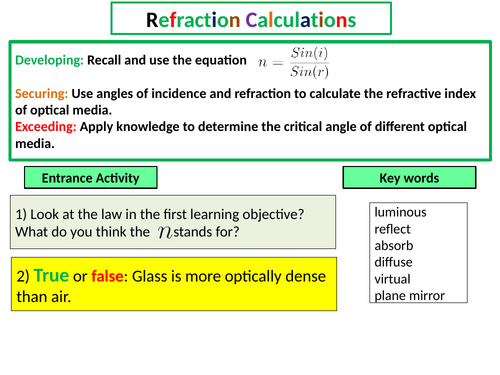
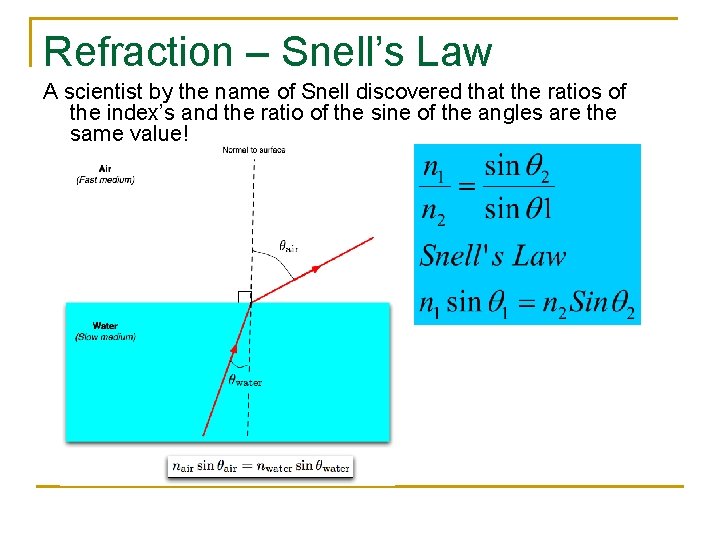
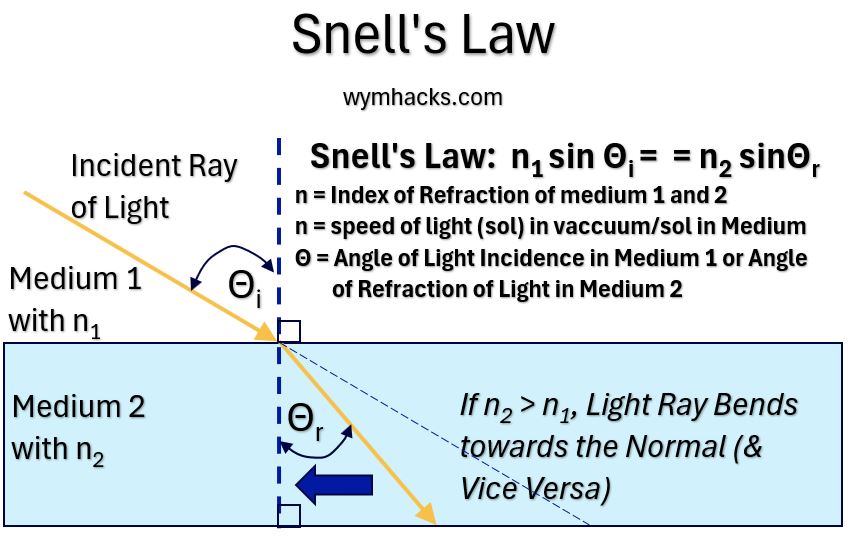
The core statement is simple: the product of a medium’s refractive index and the sine of the incident angle equals the same product for the transmitted ray. Mathematically,
n₁ sin θ₁ = n₂ sin θ₂
where n₁ and n₂ are the refractive indices of the first and second media, and θ₁ and θ₂ are the angles measured from the normal. Plug the known values in, solve for the unknown, and you have the angle of refraction.
Why the Refractive Index Matters
Refractive index is a dimension‑less number that tells how much light slows down in a material compared to a vacuum. Glass typically sits around 1.5, water at 1.33, and air barely above 1.0. The larger the index difference, the more pronounced the bend. Remember that indices can vary with wavelength—a fact called dispersion—so the same angle of incidence might produce slightly different refracted angles for red versus blue light.
Deriving the Formula from First Principles
Snell’s Law emerged from Fermat’s principle of least time. Light chooses the path that minimizes travel time, which leads to the relationship between angles and speeds (or indices). If you’re comfortable with calculus, you can derive the law by setting up the time‑of‑flight expression for a two‑segment path and differentiating with respect to the crossing point. The result reinforces the algebraic form above and explains why the law holds for any wavefront, not just visible light.
Common Pitfalls and How to Avoid Them
- Mixing degrees and radians. The sine function expects angle values in the same unit as your calculator setting. Double‑check before you hit “enter.”
- Forgetting the normal. Angles are measured from the line perpendicular to the interface, not from the surface itself. A 30° incidence actually means 30° from the normal.
- Assuming symmetry. When light travels from a denser to a rarer medium (e.g., glass to air), total internal reflection can occur if the incident angle exceeds the critical angle. In that case, Snell’s Law predicts a sine greater than 1, which is physically impossible—signaling reflection instead of refraction.
- Neglecting wavelength dependence. In high‑precision optics, ignoring dispersion can introduce errors of several degrees, especially across a broad spectrum.
Practical Tips for Accurate Refraction Calculations
Whether you’re designing a lens, setting up a laser experiment, or adjusting a camera’s underwater housing, these habits will keep your numbers reliable:
- Always write down the refractive indices of both media before you start. If the material is unknown, consult a reference table or measure it with a refractometer.
- Convert angles to the same unit system—degrees are user‑friendly, radians are calculator‑friendly. Consistency eliminates a whole class of errors.
- Use a scientific calculator or a spreadsheet function that handles inverse sine (asin) directly. This avoids manual algebra mistakes.
- When dealing with broadband light, run the calculation at the shortest wavelength of interest; the resulting angle will be the most conservative estimate.
- Document every assumption (e.g., “air index = 1.0003 at 20 °C”) so you can revisit the calculation if environmental conditions change.
Applying Snell’s Law to Real‑World Problems
Consider a simple scenario: a laser diode emits a beam at 45° into a glass slab (n = 1.52) from air (n ≈ 1.00). Plugging into the formula,
1.00 × sin 45° = 1.52 × sin θ₂ → sin θ₂ = 0.7071 / 1.52 ≈ 0.465.
Taking the arcsine gives θ₂ ≈ 27.8° measured from the normal. The beam exits the opposite side of the slab at the same angle, assuming parallel faces. If the slab were beveled, you’d repeat the calculation at the second interface, accounting for the new incident angle.
In fiber optics, the core‑cladding index contrast determines the acceptance cone, a direct application of the critical angle derived from Snell’s Law. Similarly, underwater photographers use the law to correct apparent object depth—light bends toward the normal when entering water, making objects look shallower than they truly are.
FAQ
Q: How do I find the critical angle for total internal reflection?
A: Set sin θ_c = n₂ / n₁, where n₁ is the higher index (the medium the light is leaving) and n₂ is the lower. The critical angle θ_c is the arcsine of that ratio.
Q: Does temperature affect refraction calculations?
A: Yes. Refractive indices change slightly with temperature and pressure. For high‑precision work, use temperature‑corrected index values or measure them directly.
Q: Can Snell’s Law be used for sound waves?
A: The same principle applies to any wave crossing a boundary with different propagation speeds. Replace refractive index with the ratio of sound speeds in the two media.
Mastering Snell’s Law is less about memorizing a single equation and more about understanding the physical story behind it. Keep the index values straight, respect the normal, watch for dispersion, and you’ll find that accurate refraction calculations become almost second nature.