Mastering Semi‑Annual Compound Interest: A Step‑by‑Step Guide
What Is Semi‑Annual Compounding?
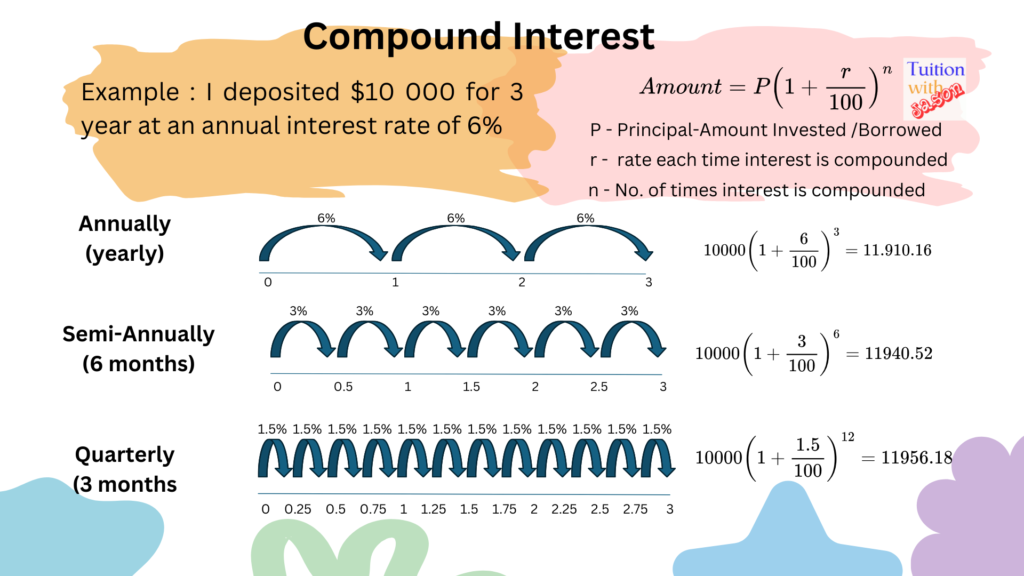
When an investment grows, the interest earned can itself earn interest. That’s compound interest. Semi‑annual compounding means interest is calculated twice a year, on the 1st and 7th of each year’s half.
Unlike simple interest, where the rate applies only to the original principal, compounding captures the power of time. Even a small difference between annual and semi‑annual rates can translate into noticeable gains over long horizons.
Why It Matters in Real Life
Financial products—savings accounts, certificates of deposit, and some bonds—use semi‑annual compounding. Knowing the precise formula lets you compare offers accurately and make smarter decisions about where to park your money.
For students, understanding the equation also builds a solid foundation for more complex concepts like continuous compounding or time‑value of money.
The Formula Explained
When interest compounds semi‑annually, the effective rate per period is half the nominal annual rate:
- r = nominal annual interest rate (decimal)
- m = number of compounding periods per year (2 for semi‑annual)
- P = principal amount
- n = total number of years the money is invested
The future value is calculated with
FV = P × (1 + r/m)^(m×n)
Each “(1 + r/m)” multiplies the amount at the end of a half‑year, and the exponent “m×n” counts how many such periods occur.
Key Points to Remember
- The exponent reflects the total number of half‑year periods.
- A higher nominal rate yields a larger effective rate when compounded more frequently.
- When comparing rates, always convert to the same compounding frequency.
Step‑by‑Step Example
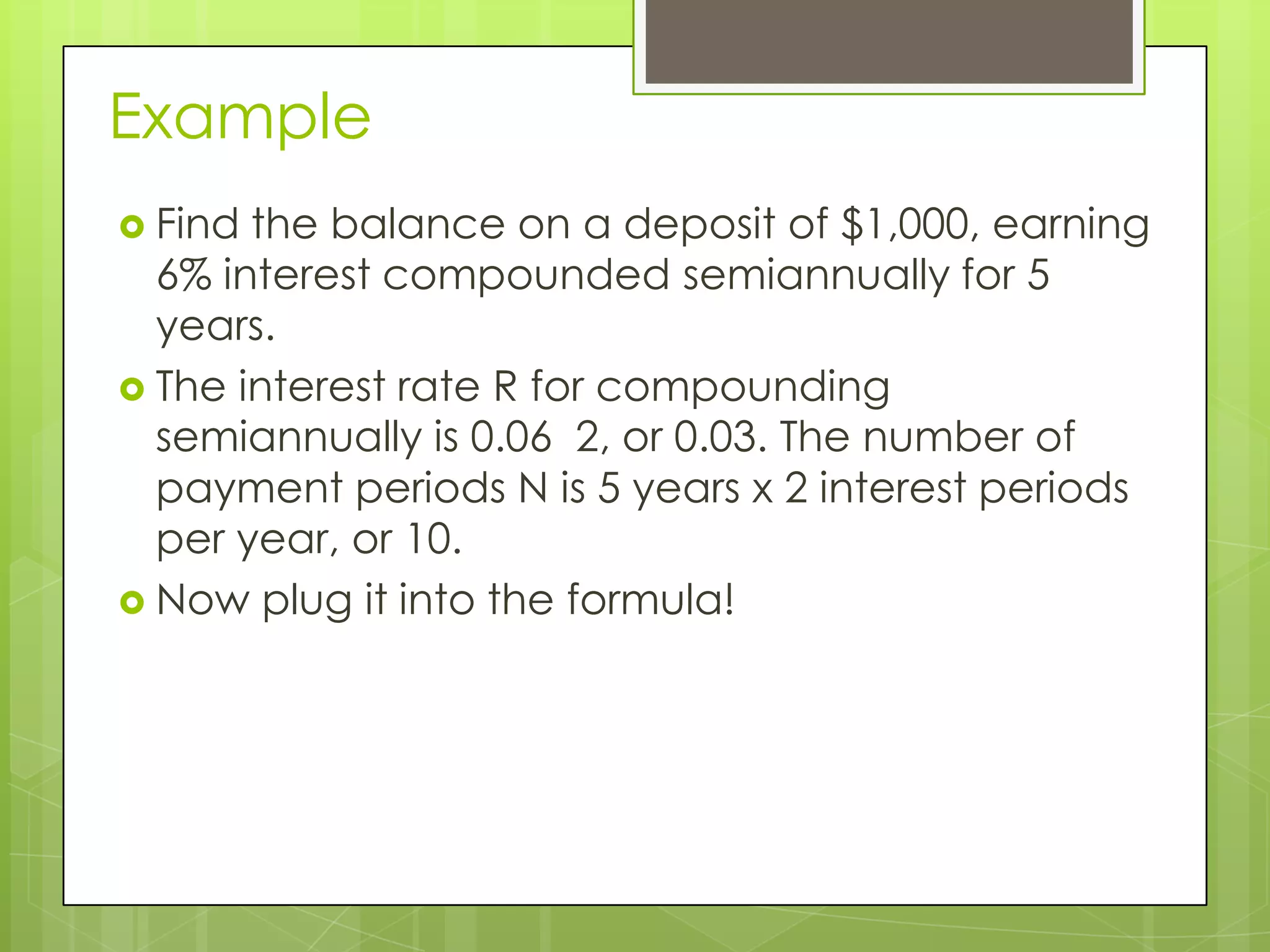
Suppose you invest $5,000 at an annual rate of 6%, compounded semi‑annually, for 4 years.
- Convert the rate: r = 0.06.
- Divide by periods: r/m = 0.06 / 2 = 0.03.
- Compute the exponent: m×n = 2 × 4 = 8.
- Plug into the formula: FV = 5,000 × (1 + 0.03)^8.
- Calculate: (1 + 0.03)^8 ≈ 1.268241.
- Multiply: 5,000 × 1.268241 ≈ $6,341.20.
After four years, your investment grows to roughly $6,341.20, illustrating how semi‑annual compounding boosts returns compared to simple interest.
Common Pitfalls to Avoid
Misreading the Rate: Treat the stated rate as if it were compounded annually when it’s actually semi‑annual.
Ignoring Periods in the Exponent: Forgetting to multiply the years by the number of periods leads to under‑estimates.
Overlooking Fees: Many accounts add monthly maintenance charges that effectively reduce the real rate.
By double‑checking each step, you safeguard against these mistakes.
When to Use Semi‑Annual vs. Annual
Financial institutions often default to semi‑annual compounding for savings accounts. If an offering states “compounded quarterly,” the same formula applies but with m = 4.
When comparing two accounts—one offering 5% annual with annual compounding, another 4.8% nominal but semi‑annual—calculate the effective annual yield (EAR) to see which truly offers more.
For long‑term planning, using the EAR allows you to line up different products on the same footing.
FAQ
- What if I have a different compounding frequency? Replace m in the formula with the appropriate number of periods per year (e.g., 12 for monthly).
- How does semi‑annual compounding compare to continuous compounding? Continuous compounding yields the highest growth; semi‑annual is lower but still higher than annual.
- Can I convert a semi‑annual rate to an equivalent annual rate? Yes, use the effective annual rate formula: EAR = (1 + r/m)^m – 1.
- Does compounding affect taxes? Interest earned is taxable, but the frequency of compounding does not change the tax bracket; it just changes the amount of taxable income.