Simple Harmonic Motion: A Class 11 Guide to Oscillations
Oscillations are at the heart of many physics problems you’ll meet in Class 11, and simple harmonic motion (SHM) is the most elementary form. In everyday life, you see it whenever a pendulum swings, a guitar string vibrates, or a spring bounces back after being stretched. This guide walks you through the core ideas, the essential formulas, and a few tricks for tackling typical exam questions—no fluff, just the concepts you need to master.
Understanding Simple Harmonic Motion
At its essence, SHM describes a periodic motion where the restoring force is directly proportional to the displacement from equilibrium and points in the opposite direction. Mathematically, that relationship is expressed as F = –k x, where k is the force constant and x the displacement. Because the force is always trying to pull the system back to its resting position, the motion repeats in a smooth sinusoidal pattern.
The defining characteristics of SHM are:
- Constant amplitude (the maximum displacement)
- Equal time intervals for equal arcs (isochronous behavior)
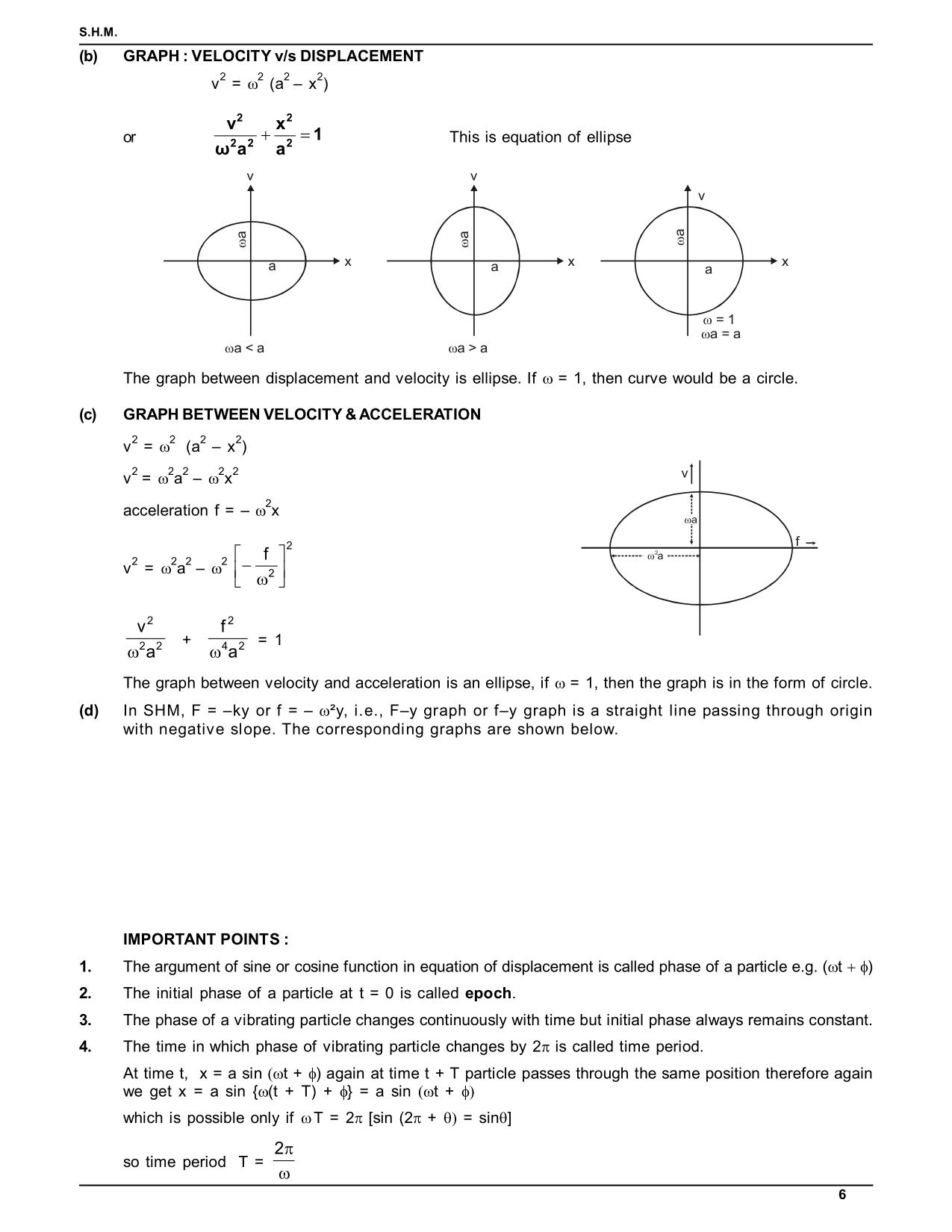
- Sinusoidal displacement, velocity, and acceleration graphs
Recognizing these traits helps you quickly decide whether a problem involves SHM or a more complicated type of oscillation.
Key Equations and Their Meaning
Once you know a system follows SHM, a handful of equations become your workbench. The displacement as a function of time is
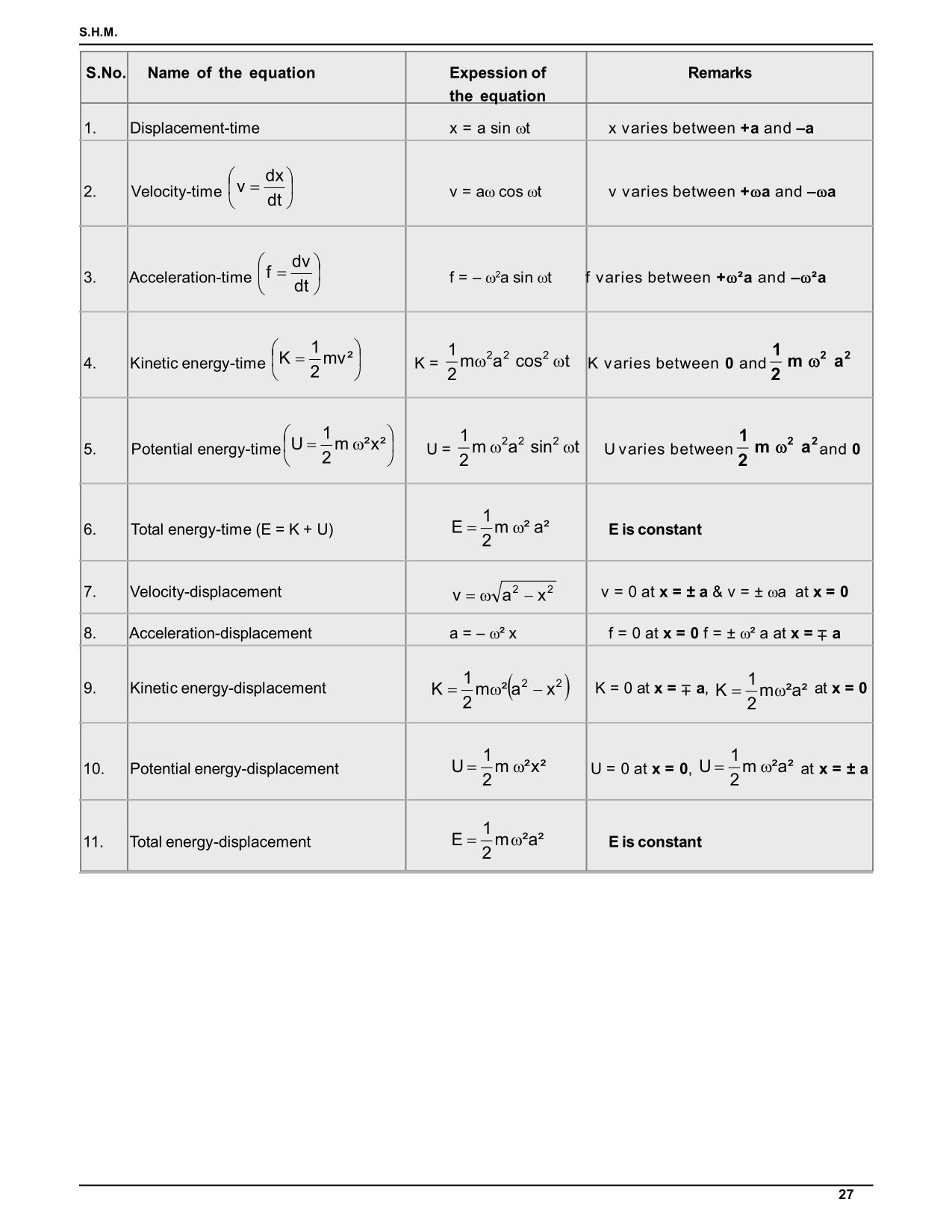
x(t) = A cos(ωt + φ),
where A is the amplitude, ω the angular frequency, and φ the phase constant. Angular frequency connects to the period (T) and frequency (f) via
ω = 2π/T = 2πf.
The acceleration follows directly from the second derivative of displacement, yielding
a(t) = –ω² x(t),
which mirrors the original restoring‑force law. For a mass‑spring system, ω = √(k/m); for a simple pendulum (small angles), ω = √(g/L). These compact forms let you jump from physical parameters to the motion’s timing without solving differential equations each time.
Energy in Simple Harmonic Motion
Energy conservation adds another intuitive layer. At any instant, the total mechanical energy E stays constant and equals the sum of kinetic (K) and potential (U) energies:
E = K + U = (1/2) m v² + (1/2) k x².
When the mass passes through equilibrium, x = 0 and all energy is kinetic; at the extremes, velocity vanishes and all energy is stored as elastic (or gravitational) potential. Plotting K and U against time shows the classic out‑of‑phase sinusoidal exchange that many students find visually reassuring.
Common Examples in Class 11
Mass‑Spring System
This is the textbook prototype. A block of mass m attached to a spring with constant k oscillates horizontally or vertically. Applying Newton’s second law gives m a = –k x, which instantly identifies the motion as SHM with ω = √(k/m). Remember to check that the spring isn’t stretched beyond its elastic limit, because the linear relationship F = –k x only holds in the elastic region.
Simple Pendulum
For small angular displacements (θ ≈ sin θ), the restoring torque is –mgL θ. The resulting angular equation mirrors the mass‑spring case, leading to ω = √(g/L). The period becomes T = 2π√(L/g), independent of mass—a fact that often surprises beginners.
LC Circuit Oscillations
Even electrical systems can exhibit SHM. In an ideal LC circuit, energy swaps between the electric field of the capacitor (½ C V²) and the magnetic field of the inductor (½ L I²). The charge on the capacitor follows q(t) = Q cos(ωt + φ) with ω = 1/√(LC), mirroring the mechanical formulas you’ve already mastered.
Tips for Solving SHM Problems
- Identify the restoring force first; if it’s proportional to displacement, you’re in SHM territory.
- Write down the appropriate ω expression before diving into algebra.
- Use energy methods when the question involves speeds at non‑extreme positions; they often bypass tedious calculus.
- Check units consistently—especially when converting between angular frequency and ordinary frequency.
- For pendulums, verify the “small‑angle” condition (θ < 10°) before applying ω = √(g/L).
Frequently Asked Questions
What distinguishes simple harmonic motion from other periodic motions?
SHM specifically requires a linear restoring force (directly proportional to displacement). Other periodic motions, like a swinging child on a swing at large angles, involve nonlinear forces and thus deviate from the simple sinusoidal pattern.
Can damping be ignored in Class 11 SHM problems?
Most textbook examples assume negligible damping, allowing the energy to stay constant. If a problem mentions air resistance or friction, you’ll need to treat it as a damped oscillator, which introduces an exponential decay factor not covered in the basic syllabus.
Why does the period of a simple pendulum not depend on its mass?
The restoring torque is proportional to the weight (mg) while the moment of inertia also contains m. These masses cancel when you derive ω = √(g/L), leaving a period that depends only on length and gravity.