Why The Night Sky Is Dark: More Than Just Missing Sunlight
It seems like a silly question, doesn’t it? We know the sky is blue during the day. We know the sun goes down at night. Therefore, the sky is dark because the blue light is gone. It’s a straightforward cause-and-effect relationship that we accept without a second thought from childhood.
But if you look closer, the explanation gets surprisingly complex. The absence of the sun is the obvious reason, but it’s not the whole story. If the universe were infinite and filled with stars, the night sky should theoretically be blazing bright, not pitch black. This contradiction has baffled astronomers and philosophers for centuries, leading to one of the most famous questions in cosmology: Olbers’ Paradox.
The Science of Daylight Blue
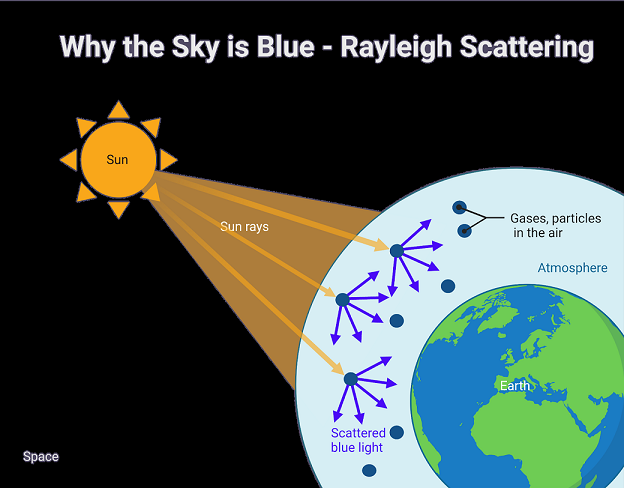
To understand why the night is black, we first have to appreciate why the day is blue. It’s not that the sky itself has a color, nor is it a reflection of the ocean (a common misconception). The effect comes from Rayleigh scattering.
When sunlight enters Earth’s atmosphere, it collides with gas molecules. Blue light, which has shorter waves, scatters in all directions much more strongly than red light, which has longer waves and passes through more easily. This scattered blue light is what fills the sky dome during the day.
At night, the source of this scattered light—the Sun—dips below the horizon. Without that intense influx of photons to scatter against our atmospheric molecules, the "blue screen" turns off. The darkness isn’t a new color; it is simply the absence of visible light reaching our eyes from above.
The Olbers’ Paradox Mystery
Here is where things get interesting. If you take a plane ride at night, you can see the sun rising or setting while you’re still in pitch-black darkness. You might think, “Well, the rest of the universe is just empty space.” But the universe isn’t empty. It’s packed with billions of galaxies, each containing billions of stars.
In an infinite, static universe, every line of sight should eventually end on a star. Even if stars are far away, their sheer number should make the entire night sky as bright as the surface of the Sun. This logical trap is known as Olbers’ Paradox. If the universe were eternal and infinite, the night sky would never be dark. It would be a wall of blinding white light.
So why isn’t it? The answer lies in the nature of our universe itself.
The Universe Is Not Static
The primary reason the night sky is dark is that the universe has a beginning. The Big Bang happened approximately 13.8 billion years ago. Light travels at a finite speed. This means we can only see light from stars and galaxies that have had enough time to reach us.
We cannot see beyond the "cosmic horizon." There are stars and galaxies that are so far away their light hasn’t reached Earth yet. In fact, much of that ancient light has been redshifted out of the visible spectrum entirely, transforming into infrared or microwave radiation, which is invisible to the naked eye.
Redshift and Expanding Space
Furthermore, the universe is expanding. As space stretches, the light traveling through it stretches too. This phenomenon is called cosmological redshift. Light from distant galaxies gets shifted toward the red end of the spectrum and eventually beyond, into invisible wavelengths. This effectively dims the background glow, contributing to the profound darkness we see at night.
Atmospheric Interference and Light Pollution
While cosmology explains why the *universe* is dark, local factors explain why our *night sky* looks the way it does. Even on a clear night, the sky isn’t perfectly black. It often has a faint twilight glow or a hazy luminance.
This is due to atmospheric scattering of remaining light sources. The moon, though it reflects sunlight, provides enough illumination to scatter against high-altitude particles, creating a faint blue-grey hue. Additionally, artificial light pollution from cities scatters off low-altitude particulate matter, creating a "skyglow" that washes out the stars and prevents the sky from achieving true blackness.
In remote locations, far from city lights, the night sky can appear almost black, revealing the Milky Way in stunning detail. Here, you see the true result of the missing sun and the finite age of the universe.
What About Other Planets?
The blue sky phenomenon is specific to Earth’s atmospheric composition and density. On Mars, for example, the sky appears pinkish or butterscotch during the day due to iron oxide dust particles. At night, Mars’ sky is much darker, but not because of a different cosmic rule—simply because the sun has set.
On Venus, the sky is a perpetual yellowish-white haze due to thick sulfuric acid clouds. Even at night, the thick atmosphere retains heat and scatters any residual light, making the concept of a "black night" much less distinct than on Earth.
The Psychological Impact of Darkness
For humans, the transition from blue to black is biological. Our eyes contain rods and cones. Cones handle color and detail in bright light; rods handle low-light vision but don’t perceive color well. As the sky darkens, we lose the ability to see the blue scatter and switch to monochromatic night vision. This shift enhances our sensitivity to contrast, making the few remaining stars pop against the dark void.
Frequently Asked Questions
Why does the sky look black in space?
In space, there is no atmosphere to scatter sunlight. Without air molecules to bounce light around, the sky remains black regardless of the sun's position, unless you are looking directly at a light source like the sun or a star.
Is the night sky actually empty?
No, it is filled with galaxies, stars, and cosmic dust. However, most of this matter is too far away for their light to have reached us yet, or the light has been redshifted into invisible wavelengths.
Why is the sky not blue at night if there are stars?
Stars are incredibly far away. Their combined light is too faint to cause significant Rayleigh scattering in our atmosphere compared to the overwhelming brightness of the sun. The scattered starlight is negligible to the human eye.
Does the moon affect the night sky color?
Yes. During a full moon, the reflected sunlight is bright enough to scatter against atmospheric particles, giving the night sky a faint, pale blue or grey tint rather than pure black.
The Beauty of the Void
Ultimately, the darkness of the night sky is a gift. It is evidence that the universe is not static, infinite, and eternal, but dynamic, evolving, and finite in age. That black canvas allows us to see the stars, the galaxies, and the structure of the cosmos. If Olbers’ paradox were true and the night sky were bright, we would be blinded to the wonders of the deep universe. The darkness is the window through which we see history.