Euler’s Enduring Legacy: Key Math Contributions Explained
Why Euler Still Matters
When you hear the name Leonhard Euler, it’s easy to imagine a lone genius scribbling equations in the 18th‑century salons of St. Petersburg. In reality, his work laid down the very scaffolding modern mathematics still climbs on. From the way we write complex numbers to the birth of graph theory, Euler’s ideas ripple through textbooks, research papers, and even everyday technology. Understanding his contributions helps demystify the tools we take for granted today.
Foundations of Calculus and Analysis
Euler was a master of the calculus that Newton and Leibniz first invented. He introduced the notation f(x) for functions, a convention that feels as natural as breathing to anyone who studies mathematics. Moreover, his systematic use of infinite series turned vague intuition about “infinitesimals” into rigorous formulas. The famous Euler–Maclaurin summation formula, for example, bridges discrete sums and continuous integrals—a bridge still crossed by engineers designing numerical algorithms.
Complex Numbers and the Exponential Function
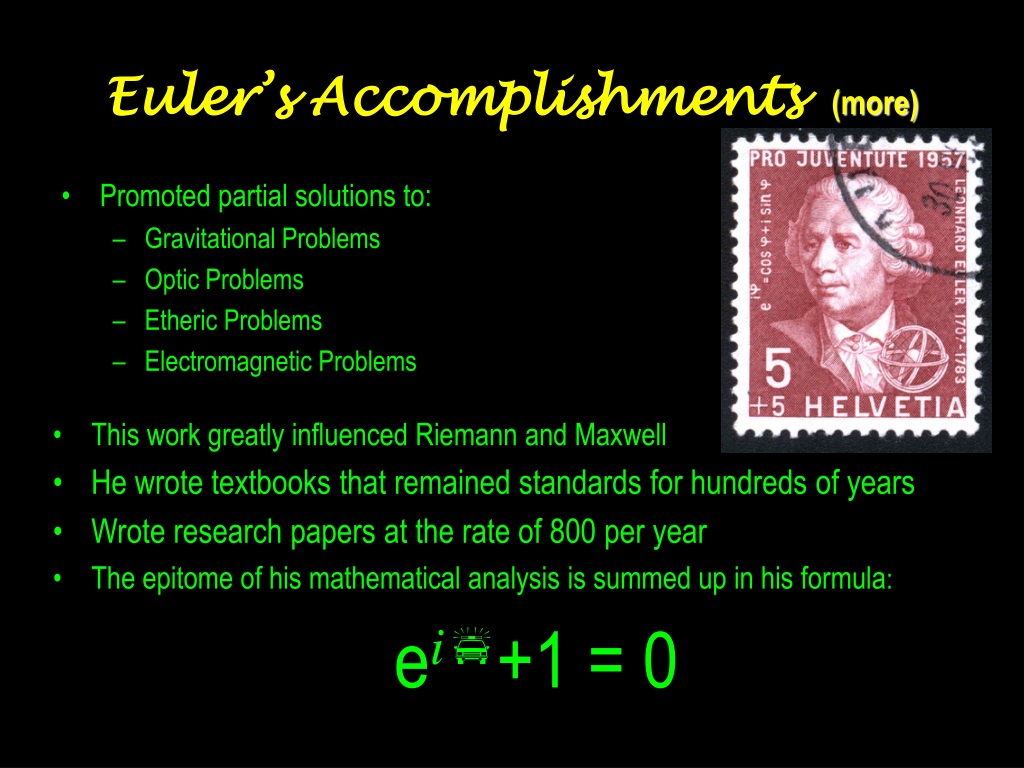
One of the most celebrated gems in Euler’s legacy is the identity eiπ + 1 = 0. This elegant equation ties together five fundamental constants—e, i, π, 1, and 0—using only addition, multiplication, and exponentiation. The formula is more than a curiosity; it underpins Fourier analysis, which in turn powers everything from signal processing to medical imaging. Without Euler’s insight that the exponential function can be extended to complex arguments, the modern world would look very different.
Graph Theory and the Seven Bridges of Königsberg
Euler’s fascination with a city’s river bridges sparked the birth of graph theory. He proved that it was impossible to walk through Königsberg and cross each of its seven bridges exactly once—a problem that seemed recreational but opened a new way to model networks. By abstracting bridges as edges and landmasses as vertices, Euler set the stage for today’s studies of computer networks, social graphs, and even molecular chemistry.
Number Theory: From Prime Counting to Partitions
Euler didn’t stop at geometry; he ventured deep into the world of integers. His product formula for the Riemann zeta function linked prime numbers to an infinite series, foreshadowing the later, more famous Riemann Hypothesis. He also discovered the generating function for partition numbers, which counts how many ways a integer can be expressed as a sum of positive integers. These results still influence combinatorics, cryptography, and the quest for prime‑based security protocols.
Euler’s Influence on Modern Mathematics
Beyond specific formulas, Euler’s greatest legacy may be his methodological spirit. He championed the idea that complex problems could be broken into simpler, more manageable pieces—an approach that resonates with today’s “divide and conquer” algorithms. His prolific output—over 800 papers and books—demonstrates a relentless curiosity that modern researchers strive to emulate.
Practical Applications You Encounter Daily
Even if you never open a textbook, Euler’s work touches your life. The algorithms that compress digital photos rely on Fourier transforms rooted in Euler’s exponential identity. Navigation apps calculate optimal routes using graph‑theoretic principles he first sketched. And the security of online banking hinges on number‑theoretic concepts that trace back to his investigations of primes.
FAQ
- What are Euler’s most famous formulas? The most iconic is eiπ + 1 = 0, but his product formula for the zeta function and the Euler–Maclaurin summation formula also rank high.
- How did Euler contribute to graph theory? By solving the Königsberg bridge problem, he introduced the notion of vertices and edges, laying the groundwork for modern network analysis.
- Why is Euler important for number theory? He linked primes to infinite series via the zeta function and created generating functions for integer partitions, both of which remain central to contemporary research.