Keysight and Agilent IO Libraries: A Technical Deep Dive
When engineers talk about automated test equipment, the Keysight & Agilent IO Libraries often come up as the backbone of device‑to‑device communication. These libraries provide a unified API for controlling a wide range of instruments—from oscilloscopes and signal generators to power supplies and spectrum analyzers—over standard interfaces such as GPIB, USB, Ethernet, and more. In this article we’ll unpack how the libraries evolved, what core features they offer, and best practices for leveraging them in modern test systems.
What Are IO Libraries?
The IO Libraries are a collection of software modules that abstract the low‑level communication details of test instruments. At their heart, they expose a set of session objects that represent a physical connection to a device, while handling the intricacies of protocol negotiation, error checking, and data transfer. By standardizing this layer, developers can write code that works with any instrument that the library supports, without having to deal with vendor‑specific quirks.
Historical Roots: From Agilent to Keysight
Agilent Technologies, founded in 1999 after the split of Hewlett Packard, was a pioneer in test and measurement solutions. In 2014, the company rebranded as Keysight Technologies after spinning off its imaging division. The IO Libraries that many people use today originated in Agilent’s software suite and were carried forward into the Keysight brand. This continuity means that legacy scripts written for Agilent instruments still run smoothly on the latest Keysight platforms, a critical factor for many long‑term test setups.
Core Features of the IO Libraries
While the libraries are extensive, a few core capabilities make them stand out:
- Device Discovery – Automatic detection of all instruments on a given network or bus.
- Session Management – Handles opening, closing, and re‑using communication channels.
- Transport Abstraction – Unified interface for GPIB, USB, LAN, Serial, and PCIe.
- Error Handling – Standardized error codes and retry logic.
- Extensibility – Plug‑in architecture for custom commands and protocol extensions.
Device Discovery and Session Management
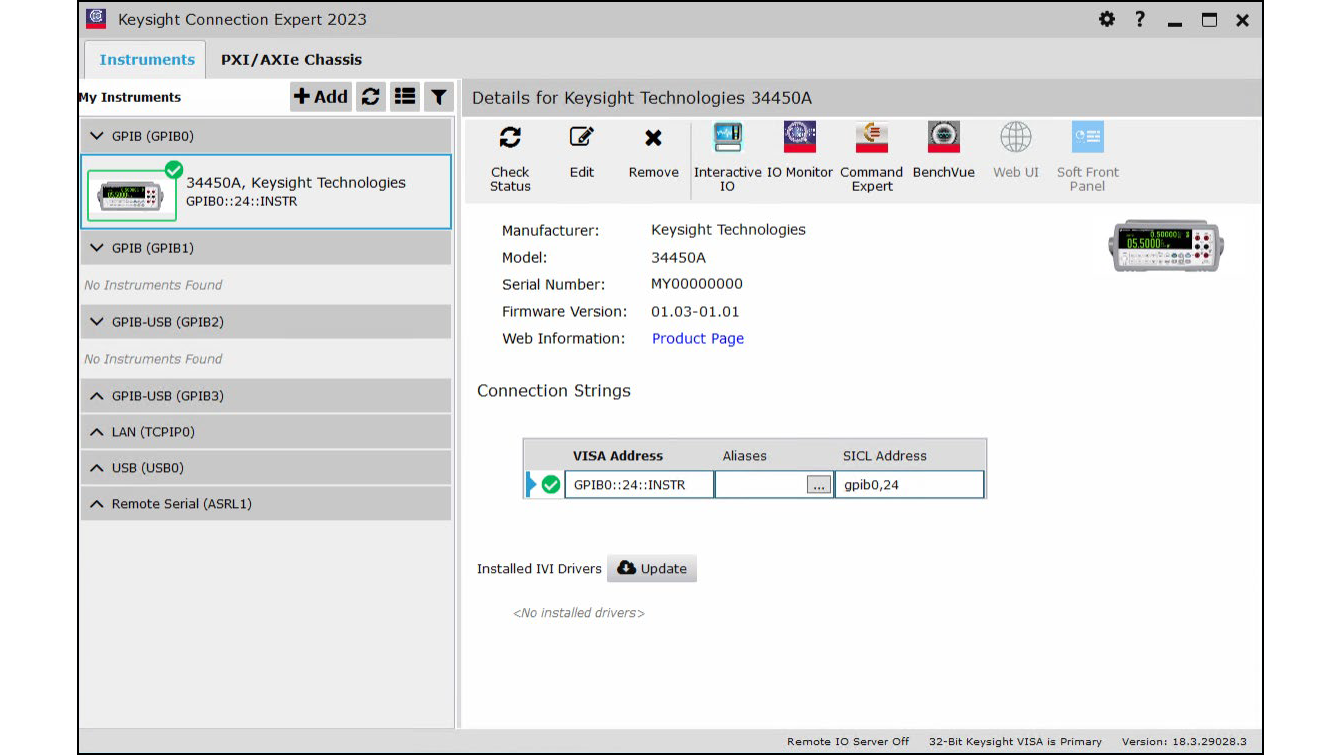
Discovery is performed via the Resource Manager, which queries the underlying bus for active devices. Once a resource name (e.g., “USB0::0x0957::0x2000::MY123456::INSTR”) is obtained, the session object encapsulates that connection. Developers can then issue commands or retrieve measurements with a single method call, freeing them from manual socket handling.
Transport Abstraction Layers
The libraries support several transport layers, each with its own strengths:
- GPIB – Ideal for legacy instruments and high‑speed parallel data transfer.
- USB – Plug‑and‑play with no additional cabling required.
- Ethernet (LAN) – Enables remote access over a network, ideal for distributed labs.
- Serial (RS‑232) – Simple but limited bandwidth; still used in niche applications.
- PCIe – Direct board‑to‑board communication for very high throughput.